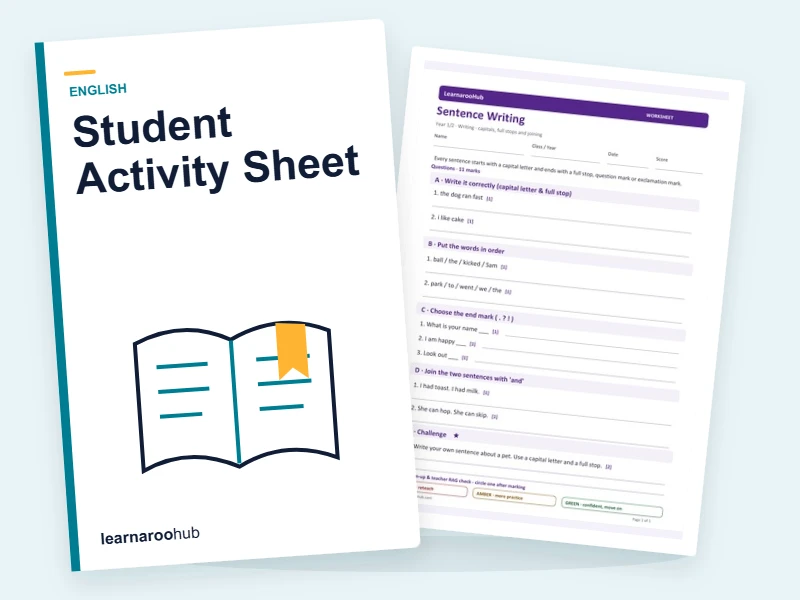
 KS1 Sentence Writing: Student Activity Sheet
Year 1 writing worksheet — capital letters, full stops, identifying complete sentences, and writing your own.
Key Stage 1 English ⏱ 15m
Printable / PDF
· 15m
PAID
Open resource →
KS1 Sentence Writing: Student Activity Sheet
Year 1 writing worksheet — capital letters, full stops, identifying complete sentences, and writing your own.
Key Stage 1 English ⏱ 15m
Printable / PDF
· 15m
PAID
Open resource →
E-Learning ModulePaid subscription
For Parents: Helping with Sentence Writing
Prefer not to join? Buy just this resource
One-off price: £1.29
This resource is also included with eligible paid plans.
Buy this resource — £1.29Create a free Learning Locker first; the exact resource and price are confirmed before payment.
Related modules
KS1 Sentence Writing: Student Activity Sheet
Year 1 writing worksheet — capital letters, full stops, identifying complete sentences, and writing your own.
Key Stage 1 English ⏱ 15m
Printable / PDF
· 15m
PAID
Open resource →
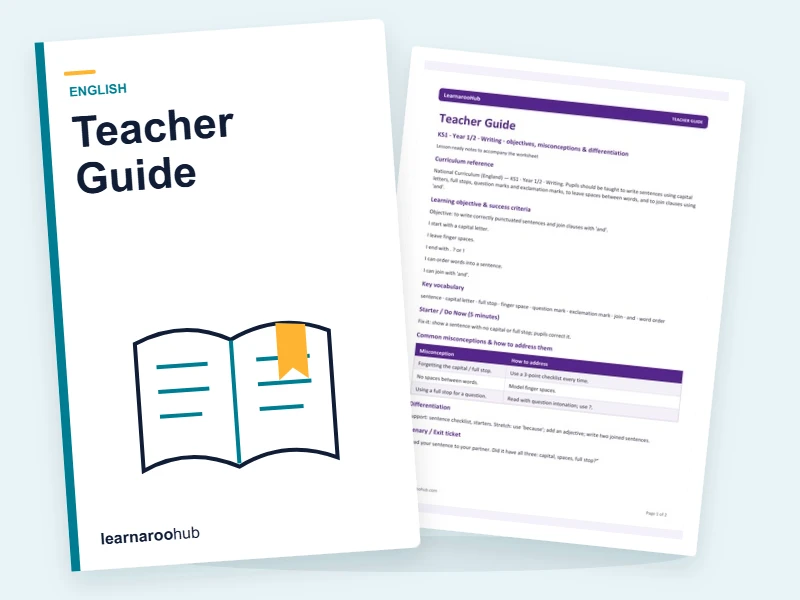 KS1 Sentence Writing: Teacher Guide
Teaching notes for KS1 sentence writing: learning objectives, vocabulary, common misconceptions, differentiation and …
Key Stage 1 English ⏱ 15m
Printable / PDF
· 15m
PAID
Open resource →
KS1 Sentence Writing: Teacher Guide
Teaching notes for KS1 sentence writing: learning objectives, vocabulary, common misconceptions, differentiation and …
Key Stage 1 English ⏱ 15m
Printable / PDF
· 15m
PAID
Open resource →
 KS1 Sentence Writing: Rules Flashcards
14 flashcards covering capital letters, punctuation and sentence types. Tap to flip.
Key Stage 1 English ⏱ 15m
Flashcard Deck
· 15m
PAID
Open resource →
KS1 Sentence Writing: Rules Flashcards
14 flashcards covering capital letters, punctuation and sentence types. Tap to flip.
Key Stage 1 English ⏱ 15m
Flashcard Deck
· 15m
PAID
Open resource →
 KS1 Sentence Writing: Interactive Lesson
A 5-slide lesson on building proper sentences — capital letters, full stops, and what makes a sentence complete.
Key Stage 1 English ⏱ 7m
E-Learning Module
· 7m
PAID
Open resource →
KS1 Sentence Writing: Interactive Lesson
A 5-slide lesson on building proper sentences — capital letters, full stops, and what makes a sentence complete.
Key Stage 1 English ⏱ 7m
E-Learning Module
· 7m
PAID
Open resource →