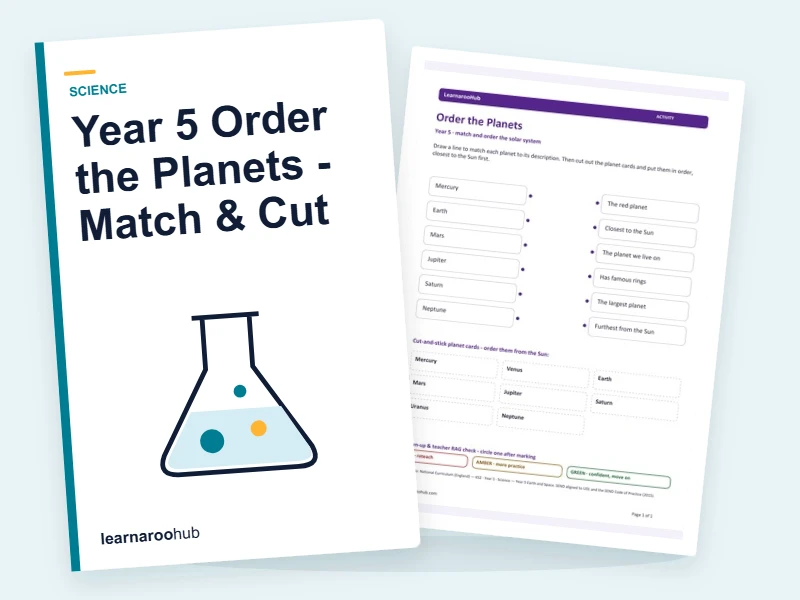
 Year 5 Order the Planets – Match & Cut
Printable Year 5 science matching and cut-and-stick activity to order the planets from the Sun, with answer key.
Key Stage 2 Science ⏱ 20m
Printable / PDF
· 20m
PAID
Open resource →
Year 5 Order the Planets – Match & Cut
Printable Year 5 science matching and cut-and-stick activity to order the planets from the Sun, with answer key.
Key Stage 2 Science ⏱ 20m
Printable / PDF
· 20m
PAID
Open resource →
E-Learning ModulePaid subscriptionIncludes a check
Master the Water Cycle
Prefer not to join? Buy just this resource
One-off price: £1.29
This resource is also included with eligible paid plans.
Buy this resource — £1.29Create a free Learning Locker first; the exact resource and price are confirmed before payment.
Related modules
Year 5 Order the Planets – Match & Cut
Printable Year 5 science matching and cut-and-stick activity to order the planets from the Sun, with answer key.
Key Stage 2 Science ⏱ 20m
Printable / PDF
· 20m
PAID
Open resource →
 KS2 Science — Module 5: Forces & magnets
Module 5 of 7 in the KS2 Science (Years 3-6) — Gated Series series — KS2 · forces & magnets. Interactive teaching, fl…
Key Stage 2 Science ⏱ 18m
E-Learning Module
· 18m
PAID
Open resource →
KS2 Science — Module 5: Forces & magnets
Module 5 of 7 in the KS2 Science (Years 3-6) — Gated Series series — KS2 · forces & magnets. Interactive teaching, fl…
Key Stage 2 Science ⏱ 18m
E-Learning Module
· 18m
PAID
Open resource →
 KS2 Science — Module 1: States of matter
Module 1 of 7 in the KS2 Science — Physics, Chemistry & Biology (Years 3–6) — Gated Series series — KS2 Science Y…
Key Stage 2 Science ⏱ 20m
E-Learning Module
· 20m
PAID
Open resource →
KS2 Science — Module 1: States of matter
Module 1 of 7 in the KS2 Science — Physics, Chemistry & Biology (Years 3–6) — Gated Series series — KS2 Science Y…
Key Stage 2 Science ⏱ 20m
E-Learning Module
· 20m
PAID
Open resource →
 KS2 Science: States of Matter — Quick Burst
A fast, self-marking Year 4 states-of-matter quick burst: eighteen snappy questions on solids, liquids and gases, cha…
Key Stage 2 Science ⏱ 20m
Activity Book
· 20m
PAID
Open resource →
KS2 Science: States of Matter — Quick Burst
A fast, self-marking Year 4 states-of-matter quick burst: eighteen snappy questions on solids, liquids and gases, cha…
Key Stage 2 Science ⏱ 20m
Activity Book
· 20m
PAID
Open resource →
