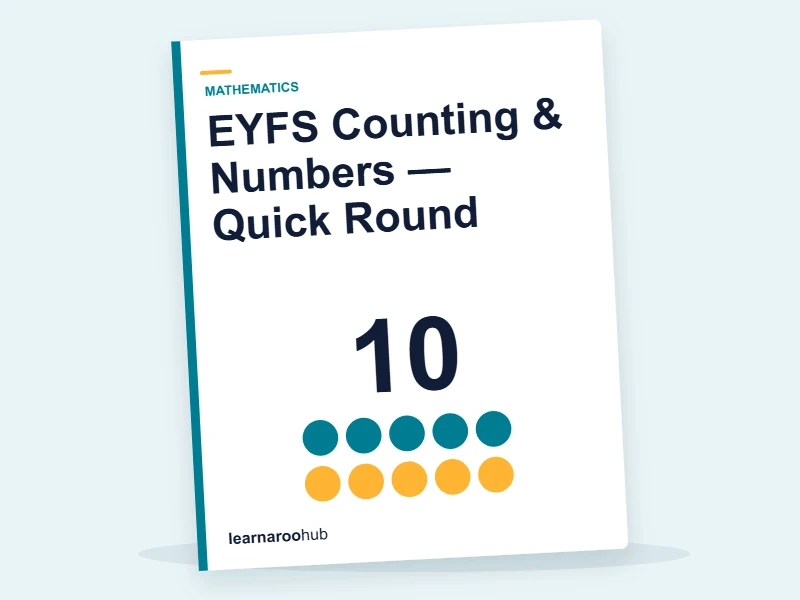
 EYFS Counting & Numbers — Quick Round
A quick, playful round for Early Years — counting & numbers. Made for little ones, with grown-up help! Reshuffles eve…
Early Years (EYFS) Mathematics ⏱ 15m
Quiz
· 15m
FREE
Open resource →
EYFS Counting & Numbers — Quick Round
A quick, playful round for Early Years — counting & numbers. Made for little ones, with grown-up help! Reshuffles eve…
Early Years (EYFS) Mathematics ⏱ 15m
Quiz
· 15m
FREE
Open resource →
Activity BookFree to use
More, Fewer or the Same? (EYFS)
More, Fewer or the Same?
Not tracking — create a free account to save your progress.Create free account →
Tip: pinch to zoom on mobile, or use the + / − buttons.
Sign in to mark this as complete and track it on your dashboard.Sign in →
Related modules
EYFS Counting & Numbers — Quick Round
A quick, playful round for Early Years — counting & numbers. Made for little ones, with grown-up help! Reshuffles eve…
Early Years (EYFS) Mathematics ⏱ 15m
Quiz
· 15m
FREE
Open resource →
 EYFS Mathematics — Module 6: Size, patterns & measure
Module 6 of 7 in the EYFS Mathematics (Reception) — Gated Series series — EYFS Maths / measure. Interactive teaching,…
Early Years (EYFS) Mathematics ⏱ 20m
E-Learning Module
· 20m
FREE
Open resource →
EYFS Mathematics — Module 6: Size, patterns & measure
Module 6 of 7 in the EYFS Mathematics (Reception) — Gated Series series — EYFS Maths / measure. Interactive teaching,…
Early Years (EYFS) Mathematics ⏱ 20m
E-Learning Module
· 20m
FREE
Open resource →
 2D shapes — Quiz Game
A fun, interactive quiz game on 2D shapes. Solo to track progress, or pass-and-play with up to 6 players or teams.
Early Years (EYFS) Mathematics ⏱ 15m
Quiz
· 15m
FREE
Open resource →
2D shapes — Quiz Game
A fun, interactive quiz game on 2D shapes. Solo to track progress, or pass-and-play with up to 6 players or teams.
Early Years (EYFS) Mathematics ⏱ 15m
Quiz
· 15m
FREE
Open resource →
 EYFS Mathematics — Module 4: Adding & taking away
Module 4 of 7 in the EYFS Mathematics (Reception) — Gated Series series — EYFS Maths / number. Interactive teaching, …
Early Years (EYFS) Mathematics ⏱ 20m
E-Learning Module
· 20m
FREE
Open resource →
EYFS Mathematics — Module 4: Adding & taking away
Module 4 of 7 in the EYFS Mathematics (Reception) — Gated Series series — EYFS Maths / number. Interactive teaching, …
Early Years (EYFS) Mathematics ⏱ 20m
E-Learning Module
· 20m
FREE
Open resource →
 EYFS Mathematics — Learning Check Quiz
A mixed-topic Mathematics learning check for EYFS. Practise solo, or take turns with up to six players or teams. Ther…
Early Years (EYFS) Mathematics ⏱ 15m
Quiz
· 15m
FREE
Open resource →
EYFS Mathematics — Learning Check Quiz
A mixed-topic Mathematics learning check for EYFS. Practise solo, or take turns with up to six players or teams. Ther…
Early Years (EYFS) Mathematics ⏱ 15m
Quiz
· 15m
FREE
Open resource →
 More, fewer, same — Speed Round
A fast all-multiple-choice Speed Round on More, fewer, same. Beat the clock solo, or play with up to 6 players or teams.
Early Years (EYFS) Mathematics ⏱ 15m
Quiz
· 15m
FREE
Open resource →
More, fewer, same — Speed Round
A fast all-multiple-choice Speed Round on More, fewer, same. Beat the clock solo, or play with up to 6 players or teams.
Early Years (EYFS) Mathematics ⏱ 15m
Quiz
· 15m
FREE
Open resource →
 More, fewer, same — Quiz Game
A fun, interactive quiz game on More, fewer, same. Solo to track progress, or pass-and-play with up to 6 players or t…
Early Years (EYFS) Mathematics ⏱ 15m
Quiz
· 15m
FREE
Open resource →
More, fewer, same — Quiz Game
A fun, interactive quiz game on More, fewer, same. Solo to track progress, or pass-and-play with up to 6 players or t…
Early Years (EYFS) Mathematics ⏱ 15m
Quiz
· 15m
FREE
Open resource →
 EYFS Mathematics — Module 3: More, fewer, same
Module 3 of 7 in the EYFS Mathematics (Reception) — Gated Series series — EYFS Maths / compare. Interactive teaching,…
Early Years (EYFS) Mathematics ⏱ 20m
E-Learning Module
· 20m
FREE
Open resource →
EYFS Mathematics — Module 3: More, fewer, same
Module 3 of 7 in the EYFS Mathematics (Reception) — Gated Series series — EYFS Maths / compare. Interactive teaching,…
Early Years (EYFS) Mathematics ⏱ 20m
E-Learning Module
· 20m
FREE
Open resource →
