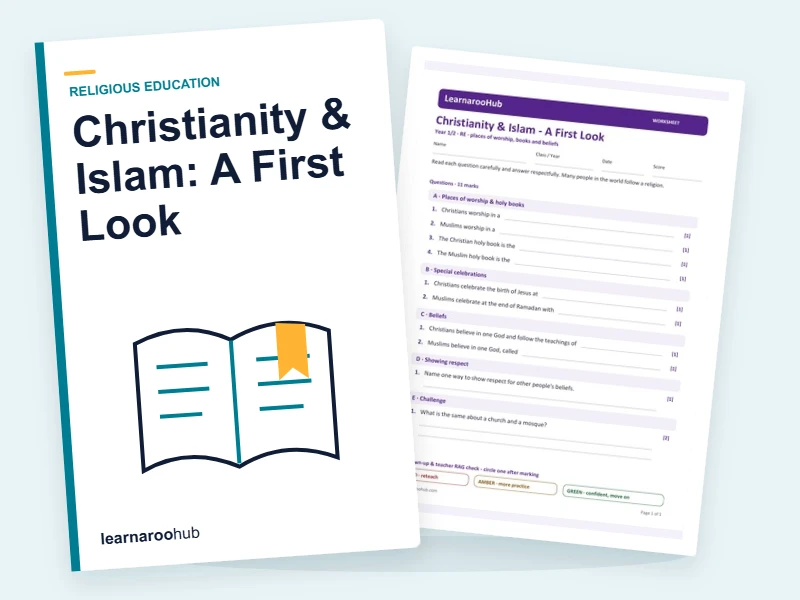
 Christianity & Islam: A First Look
One-page KS1 RE knowledge check on Christianity and Islam: places of worship, holy books, celebrations, beliefs and r…
Key Stage 1 Religious Education ⏱ 15m
Printable / PDF
· 15m
PAID
Open resource →
Christianity & Islam: A First Look
One-page KS1 RE knowledge check on Christianity and Islam: places of worship, holy books, celebrations, beliefs and r…
Key Stage 1 Religious Education ⏱ 15m
Printable / PDF
· 15m
PAID
Open resource →
E-Learning ModulePaid subscription
What People Believe: A Friendly Tour
Prefer not to join? Buy just this resource
One-off price: £1.29
This resource is also included with eligible paid plans.
Buy this resource — £1.29Create a free Learning Locker first; the exact resource and price are confirmed before payment.
Related modules
Christianity & Islam: A First Look
One-page KS1 RE knowledge check on Christianity and Islam: places of worship, holy books, celebrations, beliefs and r…
Key Stage 1 Religious Education ⏱ 15m
Printable / PDF
· 15m
PAID
Open resource →
 Christianity & Islam Quiz
10 questions on the two religions — holy books, places of worship, festivals, key beliefs, and the things they share.
Key Stage 1 Religious Education ⏱ 20m
Quiz
· 20m
PAID
Open resource →
Christianity & Islam Quiz
10 questions on the two religions — holy books, places of worship, festivals, key beliefs, and the things they share.
Key Stage 1 Religious Education ⏱ 20m
Quiz
· 20m
PAID
Open resource →
 Religion Words: Flashcards
12 flip cards covering key RE vocabulary across Christianity and Islam: God, prayer, holy book, festival, Bible, Qur'…
Key Stage 1 Religious Education ⏱ 15m
Flashcard Deck
· 15m
PAID
Open resource →
Religion Words: Flashcards
12 flip cards covering key RE vocabulary across Christianity and Islam: God, prayer, holy book, festival, Bible, Qur'…
Key Stage 1 Religious Education ⏱ 15m
Flashcard Deck
· 15m
PAID
Open resource →
 Religion at Home: A Guide for Grown-Ups
How to support KS1 RE at home, however your family handles religion — religious, non-religious, mixed, or "we're not …
Key Stage 1 Religious Education ⏱ 6m
E-Learning Module
· 6m
PAID
Open resource →
Religion at Home: A Guide for Grown-Ups
How to support KS1 RE at home, however your family handles religion — religious, non-religious, mixed, or "we're not …
Key Stage 1 Religious Education ⏱ 6m
E-Learning Module
· 6m
PAID
Open resource →
 RE Explorer: 5-Page Investigation Book
A self-marking KS1 Religious Education activity book exploring Christianity and Islam — places of worship, festivals,…
Key Stage 1 Religious Education ⏱ 45m
Activity Book
· 45m
PAID
Open resource →
RE Explorer: 5-Page Investigation Book
A self-marking KS1 Religious Education activity book exploring Christianity and Islam — places of worship, festivals,…
Key Stage 1 Religious Education ⏱ 45m
Activity Book
· 45m
PAID
Open resource →
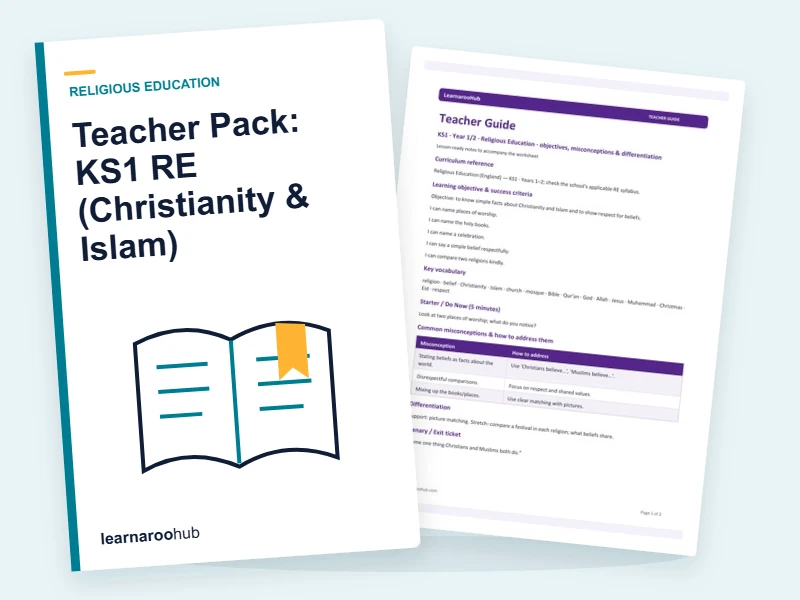 Teacher Pack: KS1 RE (Christianity & Islam)
Legal framework, the SACRE/locally agreed syllabus context, sensitivity guidance, common misconceptions to pre-empt, …
Key Stage 1 Religious Education ⏱ 30m
Printable / PDF
· 30m
PAID
Open resource →
Teacher Pack: KS1 RE (Christianity & Islam)
Legal framework, the SACRE/locally agreed syllabus context, sensitivity guidance, common misconceptions to pre-empt, …
Key Stage 1 Religious Education ⏱ 30m
Printable / PDF
· 30m
PAID
Open resource →
