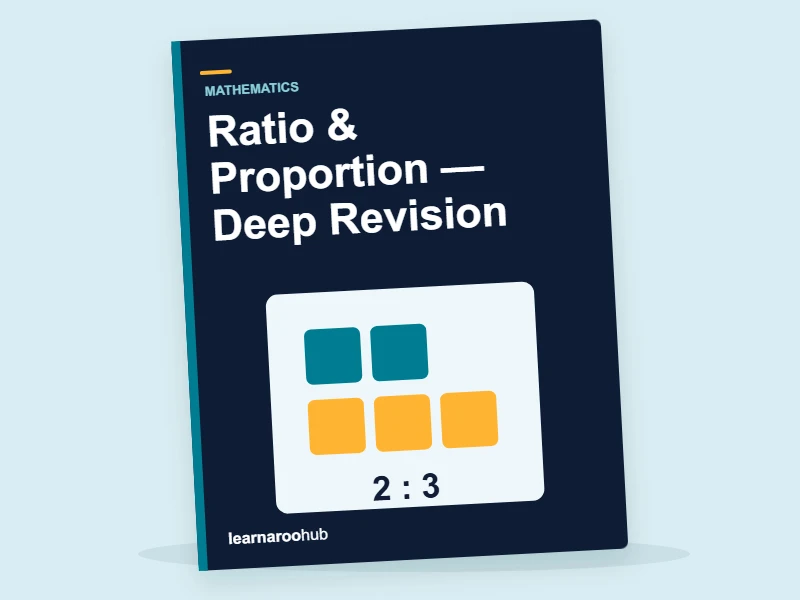
 KS3 Maths: Ratio & Proportion — Deep Revision
A longer, self-marking KS3 ratio deep-revision workbook: simplifying, sharing, unitary method, direct and inverse pro…
Key Stage 3 Mathematics ⏱ 45m
Activity Book
· 45m
PAID
Open resource →
Mock Practice PaperFree to use
KS3 Maths — Practice Paper A (Key Stage 3)
An original, exam-style Key Stage 3 (Years 7–9) maths practice paper (Set A) that bridges toward GCSE.
Not tracking — create a free account to save your progress.Create free account →
Loading your PDF…
📎 Supporting documents
Extra material to support this learning — open or download to use alongside the activity.
Sign in to mark this as complete and track it on your dashboard.Sign in →
📚 Topics to revise for this paper
Work through these topic packs to practise everything this paper tests.
Algebra — Quiz Game Algebra — Speed Round Fractions, decimals & percentages — Quiz Game Fractions, decimals & percentages — Speed Round Geometry & measures — Quiz Game Geometry & measures — Speed Round KS3 Algebra & Sequences — Challenge KS3 Algebra & Sequences — Practice (Quiz Game) KS3 Algebra & Sequences — Recall KS3 Algebra & Sequences — Speed Round KS3 Mathematics (Years 7-9) — Gated Series — Module 7: Consolidation Test (timed) KS3 Maths — Module 1: Number📚 Practise for this paper
KS3 Maths: Ratio & Proportion — Deep Revision
A longer, self-marking KS3 ratio deep-revision workbook: simplifying, sharing, unitary method, direct and inverse pro…
Key Stage 3 Mathematics ⏱ 45m
Activity Book
· 45m
PAID
Open resource →
 Fractions, decimals & percentages — Speed Round
A fast all-multiple-choice Speed Round on Fractions, decimals & percentages. Beat the clock solo, or play with up to …
Key Stage 3 Mathematics ⏱ 40m
Quiz
· 40m
PAID
Open resource →
 Year 8 Solving Equations Homework Menu
Printable KS3 solving-equations homework choice board with must-do, could-do and challenge tasks for home learning.
Key Stage 3 Mathematics ⏱ 25m
Printable / PDF
· 25m
PAID
Open resource →
 KS3 Maths: Coordinates & Transformations — Challenge
A stretch, self-marking KS3 coordinates and transformations challenge: reverse midpoints, column vectors, reflecting …
Key Stage 3 Mathematics ⏱ 30m
Activity Book
· 30m
PAID
Open resource →
 KS3 Maths: Ratio & Proportion — Support
A gentle, scaffolded KS3 ratio support workbook: small steps through simplifying ratios, sharing, ratio to fraction, …
Key Stage 3 Mathematics ⏱ 20m
Activity Book
· 20m
PAID
Open resource →
 KS3 Maths: Ratio & Proportion — Challenge
A stretch, self-marking KS3 ratio challenge: multi-part and decimal ratios, working backwards from a share, inverse p…
Key Stage 3 Mathematics ⏱ 30m
Activity Book
· 30m
PAID
Open resource →
 KS3 Maths: Statistics — Quick Burst
A fast, self-marking KS3 statistics quick-burst: fifteen snappy questions on mean, median, mode, range, bar charts, p…
Key Stage 3 Mathematics ⏱ 20m
Activity Book
· 20m
PAID
Open resource →
 KS3 Maths: Statistics — Deep Revision
A longer, self-marking KS3 statistics deep-revision workbook: averages and range from lists and frequency tables, bar…
Key Stage 3 Mathematics ⏱ 45m
Activity Book
· 45m
PAID
Open resource →
