 Mass & Temperature: Read the Scale
One-page Year 2 mass and temperature practice: 10 core marks for units, scales and temperature, plus a 2-mark optiona…
Key Stage 1 Mathematics ⏱ 15m
Printable / PDF
· 15m
PAID
Open resource →
Mass & Temperature: Read the Scale
One-page Year 2 mass and temperature practice: 10 core marks for units, scales and temperature, plus a 2-mark optiona…
Key Stage 1 Mathematics ⏱ 15m
Printable / PDF
· 15m
PAID
Open resource →
E-Learning ModulePaid subscription
Mass & Temperature: A First Look
Prefer not to join? Buy just this resource
One-off price: £1.29
This resource is also included with eligible paid plans.
Buy this resource — £1.29Create a free Learning Locker first; the exact resource and price are confirmed before payment.
Related modules
Mass & Temperature: Read the Scale
One-page Year 2 mass and temperature practice: 10 core marks for units, scales and temperature, plus a 2-mark optiona…
Key Stage 1 Mathematics ⏱ 15m
Printable / PDF
· 15m
PAID
Open resource →
 Mass & Temperature: 10-Question Quiz
10 quick questions on units, scales, thermometers and comparing — covering both Y1 and Y2 measurement content.
Key Stage 1 Mathematics ⏱ 20m
Quiz
· 20m
PAID
Open resource →
Mass & Temperature: 10-Question Quiz
10 quick questions on units, scales, thermometers and comparing — covering both Y1 and Y2 measurement content.
Key Stage 1 Mathematics ⏱ 20m
Quiz
· 20m
PAID
Open resource →
 Mass & Temperature Words: Flashcards
12 flip cards covering the words you need: mass, weight, balance, scale, gram, kilogram, thermometer, °C, freezing, b…
Key Stage 1 Mathematics ⏱ 15m
Flashcard Deck
· 15m
PAID
Open resource →
Mass & Temperature Words: Flashcards
12 flip cards covering the words you need: mass, weight, balance, scale, gram, kilogram, thermometer, °C, freezing, b…
Key Stage 1 Mathematics ⏱ 15m
Flashcard Deck
· 15m
PAID
Open resource →
 Measuring at Home: A Guide for Grown-Ups
Four kitchen-based ideas for building mass and temperature understanding — turning baking, the fridge and a winter co…
Key Stage 1 Mathematics ⏱ 5m
E-Learning Module
· 5m
PAID
Open resource →
Measuring at Home: A Guide for Grown-Ups
Four kitchen-based ideas for building mass and temperature understanding — turning baking, the fridge and a winter co…
Key Stage 1 Mathematics ⏱ 5m
E-Learning Module
· 5m
PAID
Open resource →
 Measurement Detective: 5-Page Book
A self-marking Years 1–2 measurement activity book — comparing mass, length, capacity and temperature using standard …
Key Stage 1 Mathematics ⏱ 45m
Activity Book
· 45m
PAID
Open resource →
Measurement Detective: 5-Page Book
A self-marking Years 1–2 measurement activity book — comparing mass, length, capacity and temperature using standard …
Key Stage 1 Mathematics ⏱ 45m
Activity Book
· 45m
PAID
Open resource →
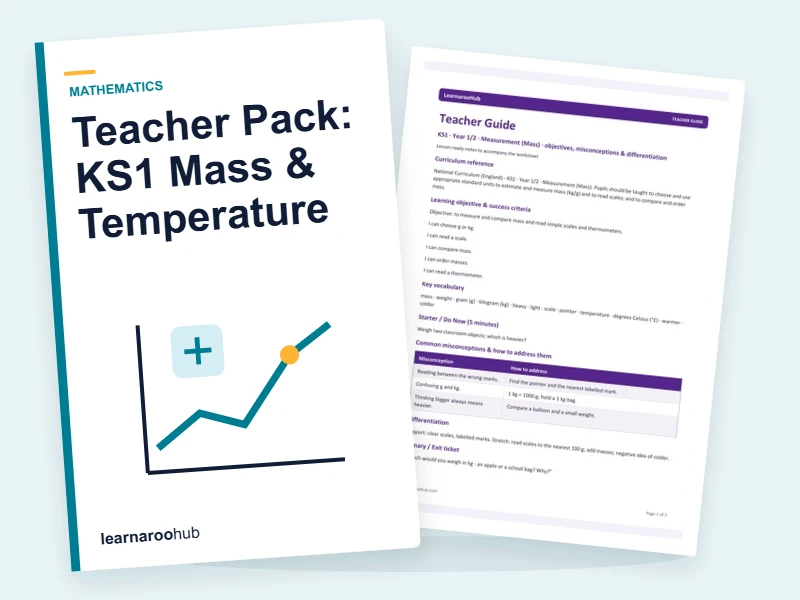 Teacher Pack: KS1 Mass & Temperature
NC mapping (Y1 + Y2 measurement), common misconceptions, key vocabulary, and a 4-lesson scheme using this pack.
Key Stage 1 Mathematics ⏱ 25m
Printable / PDF
· 25m
PAID
Open resource →
Teacher Pack: KS1 Mass & Temperature
NC mapping (Y1 + Y2 measurement), common misconceptions, key vocabulary, and a 4-lesson scheme using this pack.
Key Stage 1 Mathematics ⏱ 25m
Printable / PDF
· 25m
PAID
Open resource →
