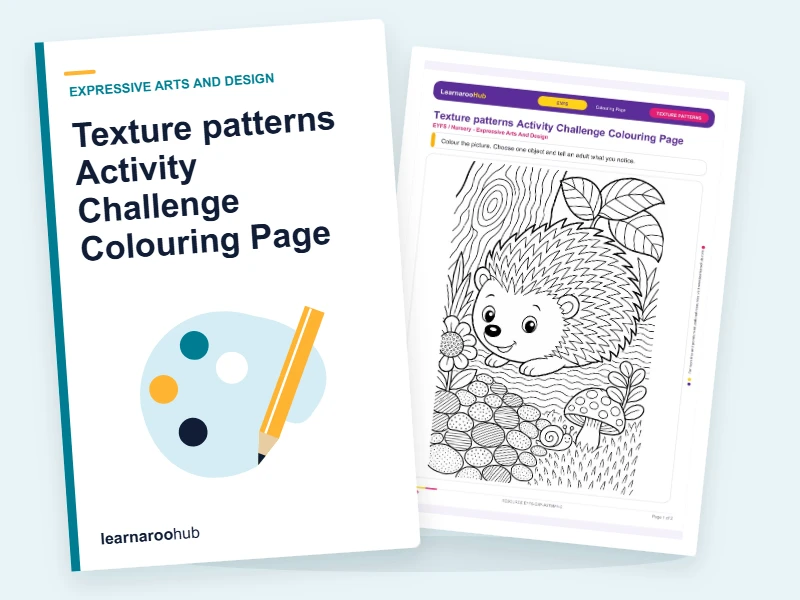
 Texture patterns Activity Challenge Colouring Page
An Early Years (EYFS) Expressive Arts and Design activity challenge on Texture patterns for use at home or in class.
Early Years (EYFS) Expressive Arts and Design ⏱ 5m
Activity Challenge
· 5m
FREE
Open resource →
Vocabulary and FactsFree to use
Imaginative play Vocabulary And Facts Colouring Page
Colour the picture and name three shapes or objects you can see.
Not tracking — create a free account to save your progress.Create free account →
Loading your PDF…
Sign in to mark this as complete and track it on your dashboard.Sign in →
Related modules
Texture patterns Activity Challenge Colouring Page
An Early Years (EYFS) Expressive Arts and Design activity challenge on Texture patterns for use at home or in class.
Early Years (EYFS) Expressive Arts and Design ⏱ 5m
Activity Challenge
· 5m
FREE
Open resource →
 EYFS Expressive Arts & Design — Module 3: Making & junk modelling
Module 3 of 7 in the EYFS Expressive Arts & Design (Reception) — Gated Series series — EYFS Arts / making. Intera…
Early Years (EYFS) Expressive Arts and Design ⏱ 20m
E-Learning Module
· 20m
FREE
Open resource →
 Music, Rhythm & Pattern (EYFS)
A gentle, parent-led Reception (EYFS) music activity book — fast and slow, loud and quiet, clap patterns, steady beat…
Early Years (EYFS) Expressive Arts and Design ⏱ 20m
Activity Book
· 20m
FREE
Open resource →
 Shape pictures Colour And Observe Colouring Page
An Early Years (EYFS) Expressive Arts and Design colour-and-observe sheet on Shape pictures for use at home or in class.
Early Years (EYFS) Expressive Arts and Design ⏱ 5m
Colour and Observe
· 5m
FREE
Open resource →

