 KS1 English: Handwriting — Deep Revision
A longer, self-marking KS1 handwriting deep-revision workbook: letter-family knowledge, capitals and tricky twins, re…
Key Stage 1 English ⏱ 45m
Activity Book
· 45m
FREE
Open resource →
KS1 English: Handwriting — Deep Revision
A longer, self-marking KS1 handwriting deep-revision workbook: letter-family knowledge, capitals and tricky twins, re…
Key Stage 1 English ⏱ 45m
Activity Book
· 45m
FREE
Open resource →
Activity BookFree to use
KS1 English: Handwriting — Quick Burst
KS1 English: Handwriting — Quick Burst is a fast-recall activity book mapped to the DfE National Curriculum for Years 1–2 handwriting.
Not tracking — create a free account to save your progress.Create free account →
Tip: pinch to zoom on mobile, or use the + / − buttons.
Sign in to mark this as complete and track it on your dashboard.Sign in →
Related modules
KS1 English: Handwriting — Deep Revision
A longer, self-marking KS1 handwriting deep-revision workbook: letter-family knowledge, capitals and tricky twins, re…
Key Stage 1 English ⏱ 45m
Activity Book
· 45m
FREE
Open resource →
 KS1 English: Handwriting — Support
A gentle, scaffolded KS1 handwriting support workbook: small steps meeting the letter families, sorting tall and smal…
Key Stage 1 English ⏱ 20m
Activity Book
· 20m
FREE
Open resource →
KS1 English: Handwriting — Support
A gentle, scaffolded KS1 handwriting support workbook: small steps meeting the letter families, sorting tall and smal…
Key Stage 1 English ⏱ 20m
Activity Book
· 20m
FREE
Open resource →
 KS1 English: Handwriting — Challenge
A stretch, self-marking KS1 handwriting challenge: sort letters across all four families, untangle harder tricky twin…
Key Stage 1 English ⏱ 30m
Activity Book
· 30m
FREE
Open resource →
KS1 English: Handwriting — Challenge
A stretch, self-marking KS1 handwriting challenge: sort letters across all four families, untangle harder tricky twin…
Key Stage 1 English ⏱ 30m
Activity Book
· 30m
FREE
Open resource →
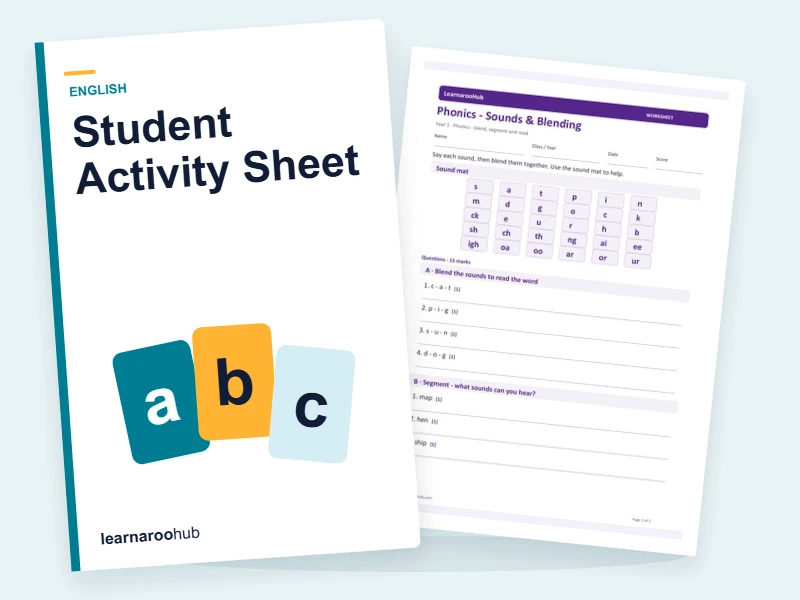 KS1 Phonics: Student Activity Sheet
Two-page Year 1 phonics worksheet with letter sounds, blending CVC words, sentence reading, and tricky-word writing p…
Key Stage 1 English ⏱ 20m
Printable / PDF
· 20m
PAID
Open resource →
KS1 Phonics: Student Activity Sheet
Two-page Year 1 phonics worksheet with letter sounds, blending CVC words, sentence reading, and tricky-word writing p…
Key Stage 1 English ⏱ 20m
Printable / PDF
· 20m
PAID
Open resource →
 Handwriting Practice KS1
A gentle Year 1 handwriting workbook — hold your pencil, form letters, capitals and digits, and leave finger spaces. …
Key Stage 1 English ⏱ 60m
Activity Book
· 60m
PAID
Open resource →
Handwriting Practice KS1
A gentle Year 1 handwriting workbook — hold your pencil, form letters, capitals and digits, and leave finger spaces. …
Key Stage 1 English ⏱ 60m
Activity Book
· 60m
PAID
Open resource →
 KS1 English Reading — Practice Paper (Set C)
A mock practice paper for practising English knowledge and skills at Key Stage 1.
Key Stage 1 English ⏱ 30m
Mock Practice Paper
· 30m
PAID
Open resource →
KS1 English Reading — Practice Paper (Set C)
A mock practice paper for practising English knowledge and skills at Key Stage 1.
Key Stage 1 English ⏱ 30m
Mock Practice Paper
· 30m
PAID
Open resource →
 KS1 English Reading — Practice Paper (Set B)
A mock practice paper for practising English knowledge and skills at Key Stage 1.
Key Stage 1 English ⏱ 30m
Mock Practice Paper
· 30m
PAID
Open resource →
KS1 English Reading — Practice Paper (Set B)
A mock practice paper for practising English knowledge and skills at Key Stage 1.
Key Stage 1 English ⏱ 30m
Mock Practice Paper
· 30m
PAID
Open resource →
 KS1 English Reading — Practice Paper (Set A)
A mock practice paper for practising English knowledge and skills at Key Stage 1.
Key Stage 1 English ⏱ 30m
Mock Practice Paper
· 30m
FREE
Open resource →
KS1 English Reading — Practice Paper (Set A)
A mock practice paper for practising English knowledge and skills at Key Stage 1.
Key Stage 1 English ⏱ 30m
Mock Practice Paper
· 30m
FREE
Open resource →
