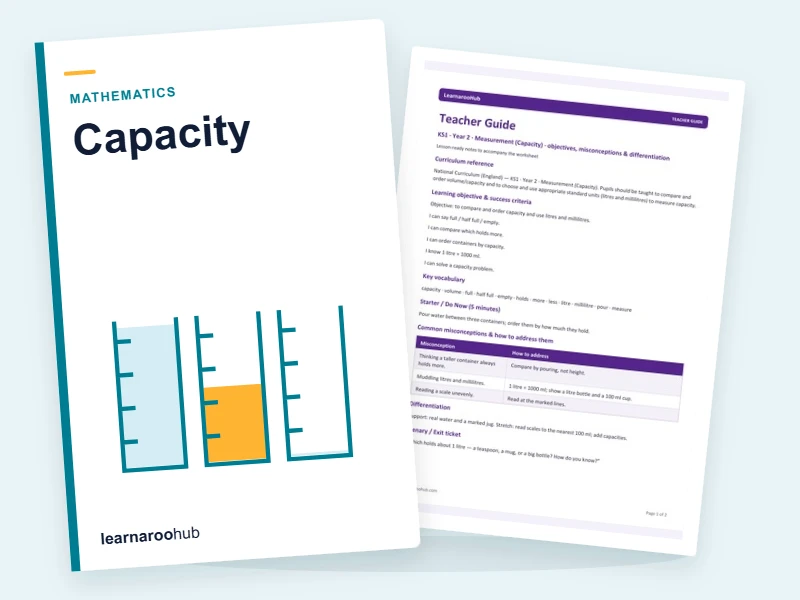
 KS1 Capacity: Teacher Guide
Teaching notes for KS1 capacity: learning objectives, vocabulary, common misconceptions, differentiation and classroo…
Key Stage 1 Mathematics ⏱ 15m
Printable / PDF
· 15m
PAID
Open resource →
Mock Practice PaperFree to use
KS1 Maths SATs — Practice Paper (Year 2)
An original, exam-style Key Stage 1 Year 2 maths practice paper.
Not tracking — create a free account to save your progress.Create free account →
Loading your PDF…
📎 Supporting documents
Extra material to support this learning — open or download to use alongside the activity.
Sign in to mark this as complete and track it on your dashboard.Sign in →
📚 Topics to revise for this paper
Work through these topic packs to practise everything this paper tests.
KS1 Place Value to 100 KS1 Introduction to Fractions KS1 Addition and Subtraction KS1 Money: Coins, Notes & Change KS1 2D & 3D Shapes KS1 Telling the Time KS1 Times Tables: 2, 5, 10 KS1 Statistics: Tally, Pictograms & Block Diagrams KS1 Length and Measuring KS1 Mass & Temperature: Measuring with Standard Units KS1 Position and Direction📚 Practise for this paper
KS1 Capacity: Teacher Guide
Teaching notes for KS1 capacity: learning objectives, vocabulary, common misconceptions, differentiation and classroo…
Key Stage 1 Mathematics ⏱ 15m
Printable / PDF
· 15m
PAID
Open resource →
 Mass & Temperature: 10-Question Quiz
10 quick questions on units, scales, thermometers and comparing — covering both Y1 and Y2 measurement content.
Key Stage 1 Mathematics ⏱ 20m
Quiz
· 20m
PAID
Open resource →
 Addition & Subtraction — Lesson 3: Topic Test
A 20-question test covering everything from Lessons 1 and 2. Unlocks after both lessons are complete.
Key Stage 1 Mathematics ⏱ 12m
E-Learning Module
· 12m
PAID
Open resource →
 KS1 Mathematics: Geometry — Properties of Shape — Deep Revision
A thorough, self-marking KS1 geometry revision book: properties of 2-D and 3-D shapes, then a real-life shape hunt, s…
Key Stage 1 Mathematics ⏱ 45m
Activity Book
· 45m
FREE
Open resource →
 KS1 Mathematics: Geometry — Properties of Shape — Support
A gentle, self-marking KS1 geometry workbook with extra tips: naming 2-D and 3-D shapes, counting sides, corners, fac…
Key Stage 1 Mathematics ⏱ 20m
Activity Book
· 20m
FREE
Open resource →
 KS1 Mathematics: Measurement — Challenge
A stretching, mostly self-marking KS1 measurement challenge book: unit comparisons, time intervals, multi-step money …
Key Stage 1 Mathematics ⏱ 30m
Activity Book
· 30m
FREE
Open resource →
 KS1 Mathematics: Measurement — Deep Revision
A thorough, self-marking KS1 measurement revision book: length, mass and money facts, then real-life shopping problem…
Key Stage 1 Mathematics ⏱ 45m
Activity Book
· 45m
FREE
Open resource →
 KS1 Mathematics: Measurement — Quick Burst
A fast, self-marking KS1 measurement warm-up: length and height, mass and capacity, telling the time, money and days.…
Key Stage 1 Mathematics ⏱ 20m
Activity Book
· 20m
FREE
Open resource →
