 KS2 Number & Calculations — Recall
A fun, varied quiz on KS2 Maths — number & calculations. Questions and answers reshuffle every play; solo is tracked,…
Key Stage 2 Mathematics ⏱ 30m
Quiz
· 30m
PAID
Open resource →
Mock Practice PaperFree to use
KS2 Maths Arithmetic — Practice Paper (Set A)
An original, exam-style KS2 Mathematics practice paper written to mirror the KS2 National Curriculum format: 40 marks, 30 minutes, with full questions and a complete marking guide.
Not tracking — create a free account to save your progress.Create free account →
Loading your PDF…
📎 Supporting documents
Extra material to support this learning — open or download to use alongside the activity.
Sign in to mark this as complete and track it on your dashboard.Sign in →
📚 Topics to revise for this paper
Work through these topic packs to practise everything this paper tests.
Algebra — Quiz Game Algebra — Speed Round Area, perimeter & volume — Quiz Game Area, perimeter & volume — Speed Round Factors, multiples & primes — Quiz Game Factors, multiples & primes — Speed Round KS2 Fractions, Decimals & Percentages — Challenge KS2 Fractions, Decimals & Percentages — Practice (Quiz Game) KS2 Fractions, Decimals & Percentages — Recall KS2 Fractions, Decimals & Percentages — Speed Round KS2 Maths — Module 1: Number & place value KS2 Maths — Module 2: The four operations📚 Practise for this paper
KS2 Number & Calculations — Recall
A fun, varied quiz on KS2 Maths — number & calculations. Questions and answers reshuffle every play; solo is tracked,…
Key Stage 2 Mathematics ⏱ 30m
Quiz
· 30m
PAID
Open resource →
 KS2 Mathematics: Number & Place Value — Support
A gentle, scaffolded KS2 number and place value support workbook: digit values, rounding, 1,000 more/less, negative n…
Key Stage 2 Mathematics ⏱ 20m
Activity Book
· 20m
PAID
Open resource →
 Master the 7 Times Table
A standalone mastery booster: KS2 · the 7 times table. Interactive teaching, flip cards, drag-and-drop and a 17-quest…
Key Stage 2 Mathematics ⏱ 12m
E-Learning Module
· 12m
PAID
Open resource →
 Year 6 SATs Maths: Multiplication & Division — Quick
A fast, self-marking Year 6 SATs multiplication and division quick-burst: fifteen snappy questions on short multiplic…
Key Stage 2 Mathematics ⏱ 20m
Activity Book
· 20m
PAID
Open resource →
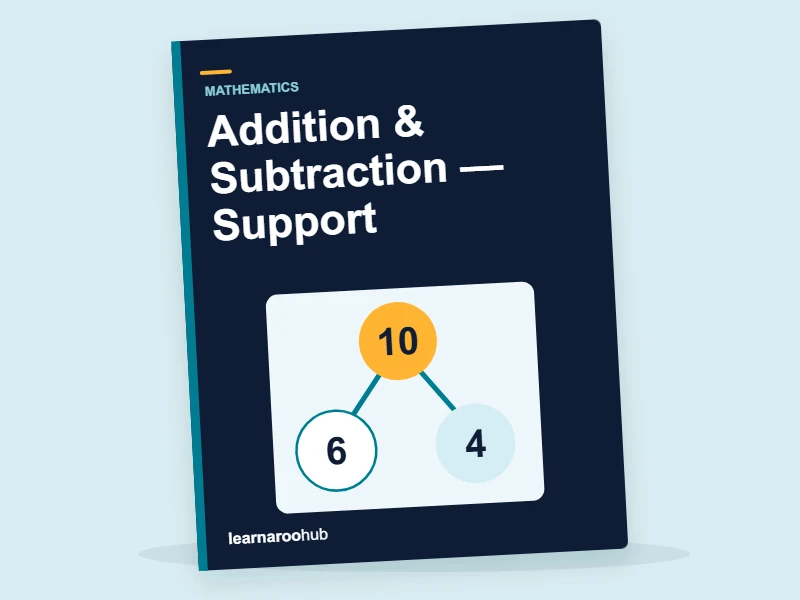 KS2 Mathematics: Addition & Subtraction — Support
A gentle, scaffolded KS2 addition and subtraction support workbook: small steps through 2- and 3-digit column additio…
Key Stage 2 Mathematics ⏱ 20m
Activity Book
· 20m
PAID
Open resource →
 KS2 Mathematics: Algebra — Challenge
A stretch, self-marking Year 6 algebra challenge: two-step number machines, formulae, two-step equations, nth-term se…
Key Stage 2 Mathematics ⏱ 30m
Activity Book
· 30m
PAID
Open resource →
 KS2 Mathematics: Algebra — Support
A gentle, scaffolded Year 6 algebra support workbook: small steps through number machines, missing numbers, simple fo…
Key Stage 2 Mathematics ⏱ 20m
Activity Book
· 20m
PAID
Open resource →
 KS2 Mathematics: Fractions, Decimals & Percentages — Challenge
A stretch, self-marking Year 5 fractions, decimals and percentages challenge: related-denominator operations, mixed n…
Key Stage 2 Mathematics ⏱ 30m
Activity Book
· 30m
PAID
Open resource →
