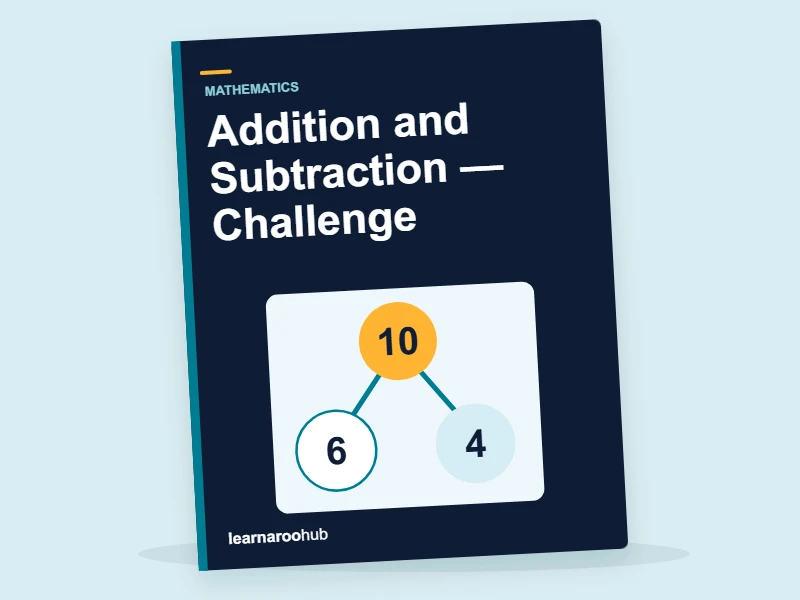
 KS1 Mathematics: Addition and Subtraction — Challenge
A stretch, self-marking KS1 addition and subtraction challenge: mental 2-digit methods, missing-number reasoning, mul…
Key Stage 1 Mathematics ⏱ 30m
Activity Book
· 30m
FREE
Open resource →
KS1 Mathematics: Addition and Subtraction — Challenge
A stretch, self-marking KS1 addition and subtraction challenge: mental 2-digit methods, missing-number reasoning, mul…
Key Stage 1 Mathematics ⏱ 30m
Activity Book
· 30m
FREE
Open resource →
Activity BookFree to use
KS1 Mathematics: Addition and Subtraction — Support
KS1 Mathematics: Addition and Subtraction — Support is a gentle, scaffolded activity book mapped to the DfE National Curriculum and designed to build confidence one skill at a time.
Not tracking — create a free account to save your progress.Create free account →
Tip: pinch to zoom on mobile, or use the + / − buttons.
Sign in to mark this as complete and track it on your dashboard.Sign in →
Related modules
KS1 Mathematics: Addition and Subtraction — Challenge
A stretch, self-marking KS1 addition and subtraction challenge: mental 2-digit methods, missing-number reasoning, mul…
Key Stage 1 Mathematics ⏱ 30m
Activity Book
· 30m
FREE
Open resource →
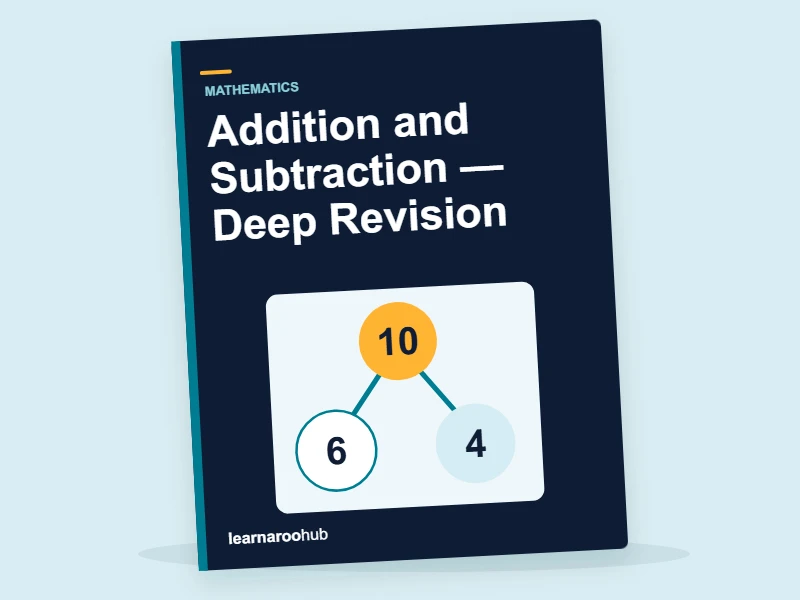 KS1 Mathematics: Addition and Subtraction — Deep Revision
A thorough, self-marking KS1 addition and subtraction revision book: number bonds and mental maths, then real-life me…
Key Stage 1 Mathematics ⏱ 45m
Activity Book
· 45m
FREE
Open resource →
KS1 Mathematics: Addition and Subtraction — Deep Revision
A thorough, self-marking KS1 addition and subtraction revision book: number bonds and mental maths, then real-life me…
Key Stage 1 Mathematics ⏱ 45m
Activity Book
· 45m
FREE
Open resource →
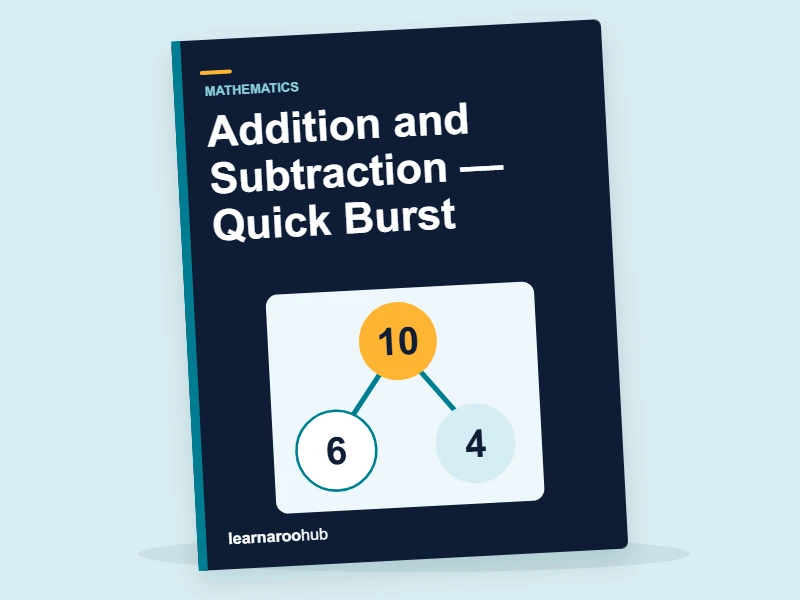 KS1 Mathematics: Addition and Subtraction — Quick Burst
A fast, self-marking KS1 addition and subtraction warm-up: number bonds to 20, fact families, mental ones-and-tens ma…
Key Stage 1 Mathematics ⏱ 20m
Activity Book
· 20m
FREE
Open resource →
KS1 Mathematics: Addition and Subtraction — Quick Burst
A fast, self-marking KS1 addition and subtraction warm-up: number bonds to 20, fact families, mental ones-and-tens ma…
Key Stage 1 Mathematics ⏱ 20m
Activity Book
· 20m
FREE
Open resource →
 Shapes — Challenge Test
15 stretch questions: multi-property sorting, symmetry reasoning, 3-D nets, identifying shapes from descriptions.
Key Stage 1 Mathematics ⏱ 20m
Quiz
· 20m
PAID
Open resource →
Shapes — Challenge Test
15 stretch questions: multi-property sorting, symmetry reasoning, 3-D nets, identifying shapes from descriptions.
Key Stage 1 Mathematics ⏱ 20m
Quiz
· 20m
PAID
Open resource →
 Master Number Bonds to 10
A standalone mastery booster: KS1 · number bonds to 10. Interactive teaching, flip cards, drag-and-drop and a 17-ques…
Key Stage 1 Mathematics ⏱ 10m
E-Learning Module
· 10m
PAID
Open resource →
Master Number Bonds to 10
A standalone mastery booster: KS1 · number bonds to 10. Interactive teaching, flip cards, drag-and-drop and a 17-ques…
Key Stage 1 Mathematics ⏱ 10m
E-Learning Module
· 10m
PAID
Open resource →
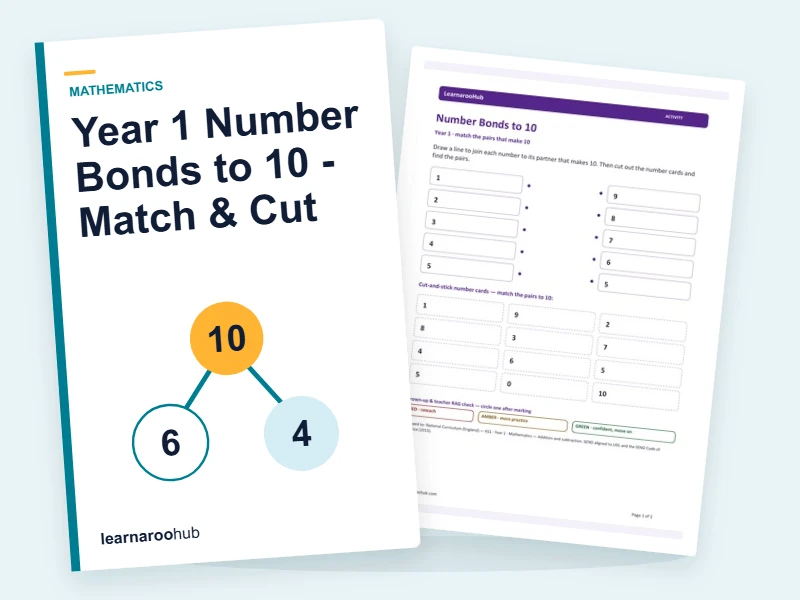 Year 1 Number Bonds to 10 – Match & Cut
Printable Year 1 number bonds to 10 matching and cut-and-stick activity, with answers.
Key Stage 1 Mathematics ⏱ 15m
Printable / PDF
· 15m
PAID
Open resource →
Year 1 Number Bonds to 10 – Match & Cut
Printable Year 1 number bonds to 10 matching and cut-and-stick activity, with answers.
Key Stage 1 Mathematics ⏱ 15m
Printable / PDF
· 15m
PAID
Open resource →
 KS1 Addition and Subtraction — Speed Round
A fast all-multiple-choice Speed Round on KS1 Addition and Subtraction. Solo to track progress, or pass-and-play with…
Key Stage 1 Mathematics ⏱ 20m
Quiz
· 20m
PAID
Open resource →
KS1 Addition and Subtraction — Speed Round
A fast all-multiple-choice Speed Round on KS1 Addition and Subtraction. Solo to track progress, or pass-and-play with…
Key Stage 1 Mathematics ⏱ 20m
Quiz
· 20m
PAID
Open resource →
 KS1 Addition & Subtraction — Speed Round
A fast all-multiple-choice Speed Round on KS1 Addition & Subtraction. Solo to track progress, or pass-and-play with u…
Key Stage 1 Mathematics ⏱ 20m
Quiz
· 20m
PAID
Open resource →
KS1 Addition & Subtraction — Speed Round
A fast all-multiple-choice Speed Round on KS1 Addition & Subtraction. Solo to track progress, or pass-and-play with u…
Key Stage 1 Mathematics ⏱ 20m
Quiz
· 20m
PAID
Open resource →
