 KS1 Science: Everyday Materials — Quick Burst
A fast, self-marking KS1 science warm-up on everyday materials: naming materials, describing properties, grouping, su…
Key Stage 1 Science ⏱ 20m
Activity Book
· 20m
FREE
Open resource →
KS1 Science: Everyday Materials — Quick Burst
A fast, self-marking KS1 science warm-up on everyday materials: naming materials, describing properties, grouping, su…
Key Stage 1 Science ⏱ 20m
Activity Book
· 20m
FREE
Open resource →
Activity BookFree to use
KS1 Science: Everyday Materials — Challenge
KS1 Science: Everyday Materials — Challenge is a stretching activity book mapped to the DfE National Curriculum for Years 1 and 2, pitched above the Quick Burst form for greater-depth learners.
Not tracking — create a free account to save your progress.Create free account →
Tip: pinch to zoom on mobile, or use the + / − buttons.
Sign in to mark this as complete and track it on your dashboard.Sign in →
Related modules
KS1 Science: Everyday Materials — Quick Burst
A fast, self-marking KS1 science warm-up on everyday materials: naming materials, describing properties, grouping, su…
Key Stage 1 Science ⏱ 20m
Activity Book
· 20m
FREE
Open resource →
 KS1 Science: Everyday Materials — Support
A gentle, self-marking KS1 science book on everyday materials, with extra tips and simple vocabulary for naming mater…
Key Stage 1 Science ⏱ 20m
Activity Book
· 20m
FREE
Open resource →
KS1 Science: Everyday Materials — Support
A gentle, self-marking KS1 science book on everyday materials, with extra tips and simple vocabulary for naming mater…
Key Stage 1 Science ⏱ 20m
Activity Book
· 20m
FREE
Open resource →
 KS1 Science: Everyday Materials — Deep Revision
A thorough, self-marking KS1 science revision book on everyday materials: naming and properties, then a home material…
Key Stage 1 Science ⏱ 45m
Activity Book
· 45m
FREE
Open resource →
KS1 Science: Everyday Materials — Deep Revision
A thorough, self-marking KS1 science revision book on everyday materials: naming and properties, then a home material…
Key Stage 1 Science ⏱ 45m
Activity Book
· 45m
FREE
Open resource →
 KS1 Science — Module 2: Plants
Module 2 of 7 in the KS1 Science (Years 1-2) — Gated Series series — KS1 · plants. Interactive teaching, flip cards, …
Key Stage 1 Science ⏱ 15m
E-Learning Module
· 15m
PAID
Open resource →
KS1 Science — Module 2: Plants
Module 2 of 7 in the KS1 Science (Years 1-2) — Gated Series series — KS1 · plants. Interactive teaching, flip cards, …
Key Stage 1 Science ⏱ 15m
E-Learning Module
· 15m
PAID
Open resource →
 Everyday Materials Detective KS1
A self-marking Year 1 science activity book — name everyday materials, work out what each object is made from, spot s…
Key Stage 1 Science ⏱ 60m
Activity Book
· 60m
PAID
Open resource →
Everyday Materials Detective KS1
A self-marking Year 1 science activity book — name everyday materials, work out what each object is made from, spot s…
Key Stage 1 Science ⏱ 60m
Activity Book
· 60m
PAID
Open resource →
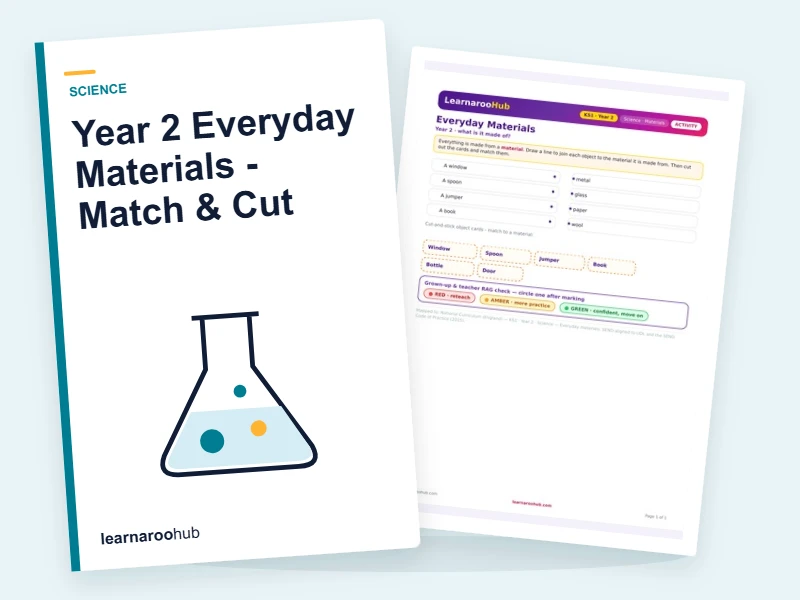 Year 2 Everyday Materials – Match & Cut
Printable Year 2 science matching activity on everyday materials, with answers.
Key Stage 1 Science ⏱ 15m
Printable / PDF
· 15m
PAID
Open resource →
Year 2 Everyday Materials – Match & Cut
Printable Year 2 science matching activity on everyday materials, with answers.
Key Stage 1 Science ⏱ 15m
Printable / PDF
· 15m
PAID
Open resource →
 KS1 Science — Module 3: Everyday materials
Module 3 of 7 in the KS1 Science (Years 1-2) — Gated Series series — KS1 · everyday materials. Interactive teaching, …
Key Stage 1 Science ⏱ 15m
E-Learning Module
· 15m
PAID
Open resource →
KS1 Science — Module 3: Everyday materials
Module 3 of 7 in the KS1 Science (Years 1-2) — Gated Series series — KS1 · everyday materials. Interactive teaching, …
Key Stage 1 Science ⏱ 15m
E-Learning Module
· 15m
PAID
Open resource →
 KS1 Science (Years 1-2) — Gated Series — Module 7: Consolidation Test (timed)
The final timed, mixed test drawing on all six modules — 16 fresh questions with full answer review. Unlocks after Mo…
Key Stage 1 Science ⏱ 20m
Quiz
· 20m
PAID
Open resource →
KS1 Science (Years 1-2) — Gated Series — Module 7: Consolidation Test (timed)
The final timed, mixed test drawing on all six modules — 16 fresh questions with full answer review. Unlocks after Mo…
Key Stage 1 Science ⏱ 20m
Quiz
· 20m
PAID
Open resource →
