 KS1 Science: Living Things and Their Habitats — Challenge
A stretching KS1 science challenge book: tricky living/dead cases, comparing habitats, micro-habitat reasoning and mu…
Key Stage 1 Science ⏱ 30m
Activity Book
· 30m
FREE
Open resource →
KS1 Science: Living Things and Their Habitats — Challenge
A stretching KS1 science challenge book: tricky living/dead cases, comparing habitats, micro-habitat reasoning and mu…
Key Stage 1 Science ⏱ 30m
Activity Book
· 30m
FREE
Open resource →
Activity BookFree to use
KS1 Science: Living Things and Their Habitats — Quick Burst
KS1 Science: Living Things and Their Habitats — Quick Burst is a fast-paced, fully auto-marked activity book mapped to the DfE National Curriculum for Year 2.
Not tracking — create a free account to save your progress.Create free account →
Tip: pinch to zoom on mobile, or use the + / − buttons.
Sign in to mark this as complete and track it on your dashboard.Sign in →
Related modules
KS1 Science: Living Things and Their Habitats — Challenge
A stretching KS1 science challenge book: tricky living/dead cases, comparing habitats, micro-habitat reasoning and mu…
Key Stage 1 Science ⏱ 30m
Activity Book
· 30m
FREE
Open resource →
 KS1 Science: Living Things and Their Habitats — Deep Revision
A thorough, self-marking KS1 science revision book: living/dead sorting and habitat basics, then real micro-habitat e…
Key Stage 1 Science ⏱ 45m
Activity Book
· 45m
FREE
Open resource →
KS1 Science: Living Things and Their Habitats — Deep Revision
A thorough, self-marking KS1 science revision book: living/dead sorting and habitat basics, then real micro-habitat e…
Key Stage 1 Science ⏱ 45m
Activity Book
· 45m
FREE
Open resource →
 KS1 Science: Living Things and Their Habitats — Support
A gentle, self-marking KS1 science workbook on living/dead/never-alive things, habitats, micro-habitats and simple fo…
Key Stage 1 Science ⏱ 20m
Activity Book
· 20m
FREE
Open resource →
KS1 Science: Living Things and Their Habitats — Support
A gentle, self-marking KS1 science workbook on living/dead/never-alive things, habitats, micro-habitats and simple fo…
Key Stage 1 Science ⏱ 20m
Activity Book
· 20m
FREE
Open resource →
 Materials — Main Test
18 questions on Y1+Y2 materials — properties, uses, suitability, grouping by property.
Key Stage 1 Science ⏱ 20m
Quiz
· 20m
PAID
Open resource →
Materials — Main Test
18 questions on Y1+Y2 materials — properties, uses, suitability, grouping by property.
Key Stage 1 Science ⏱ 20m
Quiz
· 20m
PAID
Open resource →
 Living Things & Habitats KS1
A gentle, self-marking Year 2 science activity book — sort living, dead and never-alive things, match animals to habi…
Key Stage 1 Science ⏱ 60m
Activity Book
· 60m
PAID
Open resource →
Living Things & Habitats KS1
A gentle, self-marking Year 2 science activity book — sort living, dead and never-alive things, match animals to habi…
Key Stage 1 Science ⏱ 60m
Activity Book
· 60m
PAID
Open resource →
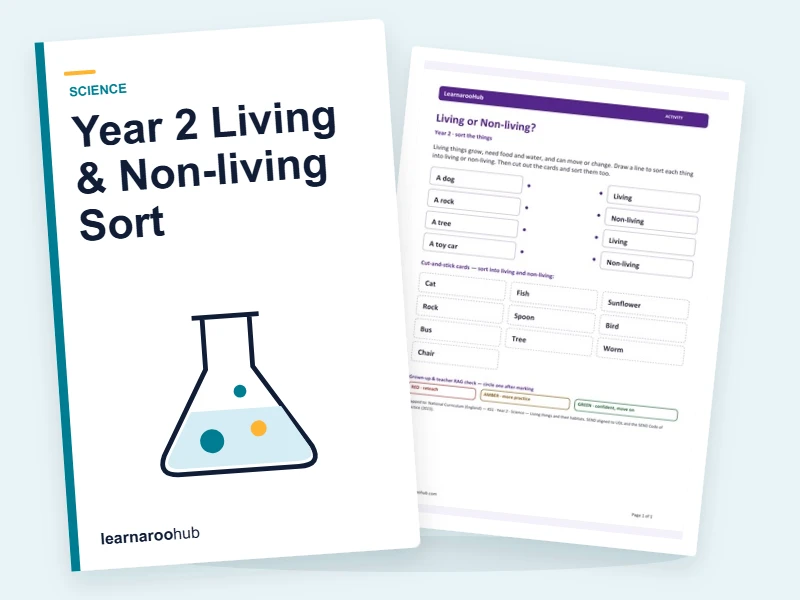 Year 2 Living & Non-living Sort
Printable Year 2 science cut-and-stick sorting activity for living and non-living things, with answers.
Key Stage 1 Science ⏱ 15m
Printable / PDF
· 15m
PAID
Open resource →
Year 2 Living & Non-living Sort
Printable Year 2 science cut-and-stick sorting activity for living and non-living things, with answers.
Key Stage 1 Science ⏱ 15m
Printable / PDF
· 15m
PAID
Open resource →
 KS1 Science — Module 4: Living things & habitats
Module 4 of 7 in the KS1 Science (Years 1-2) — Gated Series series — KS1 · living things & habitats. Interactive teac…
Key Stage 1 Science ⏱ 15m
E-Learning Module
· 15m
PAID
Open resource →
KS1 Science — Module 4: Living things & habitats
Module 4 of 7 in the KS1 Science (Years 1-2) — Gated Series series — KS1 · living things & habitats. Interactive teac…
Key Stage 1 Science ⏱ 15m
E-Learning Module
· 15m
PAID
Open resource →
 KS1 Science (Years 1-2) — Gated Series — Module 7: Consolidation Test (timed)
The final timed, mixed test drawing on all six modules — 16 fresh questions with full answer review. Unlocks after Mo…
Key Stage 1 Science ⏱ 20m
Quiz
· 20m
PAID
Open resource →
KS1 Science (Years 1-2) — Gated Series — Module 7: Consolidation Test (timed)
The final timed, mixed test drawing on all six modules — 16 fresh questions with full answer review. Unlocks after Mo…
Key Stage 1 Science ⏱ 20m
Quiz
· 20m
PAID
Open resource →
