Curriculum details
- Year group
- Year 1
- Age range
- 5–7
- Topic
- Consonant digraphs (sh, ch, th, ng)
- Curriculum reference
- Not specified
Sign up free →
Access this resource with a paid plan
This resource is included with eligible paid plans.
See plans for full-library accessAbout this resource
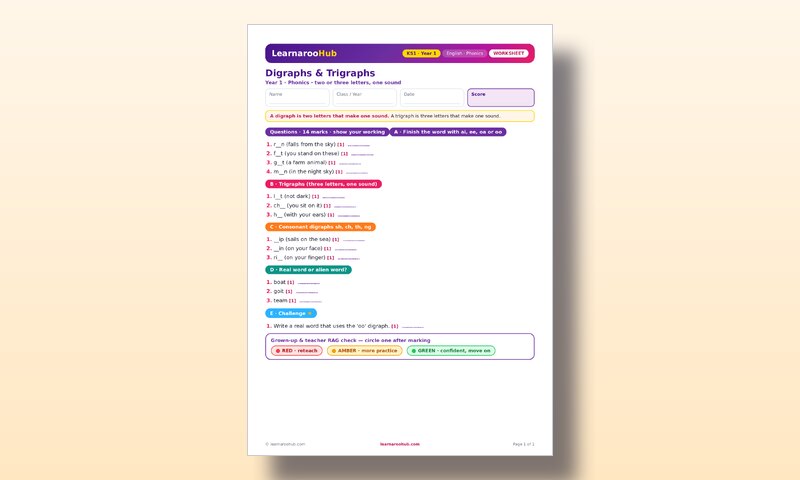
Four-page worksheet building from consonant digraphs to vowel digraphs to trigraphs, with progressive difficulty and a full answer key.
- Access
- Locked — access required
- Assessment
- Not included
- Format
- Printable / PDF
- Subject
- English
- Level
- Key stage 1
- Typical time
- 20 minutes
- Length
- 4 pages
How to study with Digraphs & Trigraphs Worksheet
This parent guide connects the page examples with a structured study routine. The listed resource is labelled English, Key stage 1, Year 1, Printable / PDF. Use that context, the learning summary and published prompts to decide what successful work should demonstrate.
Prepare a focused session
Read the title and learning focus jointly. Ask the learner to anticipate the knowledge, vocabulary or method they may need. Scan each sample and recognise instruction words, values, clues, constraints or new terms. Agree a realistic time window, reduce interruptions and prepare appropriate equipment such as paper, pencil, ruler, coloured pens, calculator, headphones or a device. Encourage an unaided opening attempt so the attempt indicates secure understanding and uncertainty. A short pause often strengthens retrieval better than an same-session answer.
Make thinking shown
Invite the learner to describe the task in their own words. They can underline key information, separate a extended problem into smaller steps, draw a representation, organise details, practise a sentence or describe a planned method. Ask why their approach fits and whether another method could work. When movement stops, provide a carefully scaled hint: state again the goal, point towards a useful example, reduce the choice, then model only the next step. Return control immediately afterwards. Spoken reasoning highlights mistakes and practises correct subject language.
Check accuracy and understanding
Compare the attempt with shown answer guidance after genuine effort. Inspect more than the final attempt: review the method, explanation, units, details, sequence, spelling or presentation where useful. Ask the learner to find the opening point where their reasoning changed course. Complete corrections actively in a different colour or fresh space, followed by a short note of the change. For a correct answer, request support and one unaided check. This distinguishes assured knowledge from guessing while strengthening accuracy, reflection and careful working habits.
Consolidate and extend
Finish with retrieval from memory. Cover the example and ask for the central idea, process or fact again. Create one small variation by altering a value, condition, example, viewpoint or level of support while keeping the learning focus. Invite the learner to write a comparable question and supply checking guidance. Record one success and one specific next step, perhaps revisiting terminology, practising a calculation, adding details or refining clarity. Recheck that target later in the week because spaced review gives stronger information than same-session repetition.
The interactive player, downloadable file and record answer material retain their existing access controls. The guide strengthens preparation, discussion and review.
What you’ll learn
Use this Printable / PDF to practise and consolidate English knowledge and skills at Key stage 1. Return to it as often as your access allows to build confidence and fluency.
Inside this printable
Here are a few exact prompts, questions or teaching points transcribed from this printable's existing preview. Use the sample to check that the resource matches your learning goal before requesting access or printing. The complete PDF and any full answer material remain subject to access.
- 1. Write a real word that uses the 'oo' digraph. [1]
- 1. r__n (falls from the sky) [1]
- 2. f__t (you stand on these) [1]
- 4. m__n (in the night sky) [1]
- 3. g__t (a farm animal) [1]
Resource preview
Four-page worksheet building from consonant digraphs to vowel digraphs to trigraphs, with progressive difficulty and a full answer key.
This preview uses the public resource summary only. The activity and any files remain protected until access is granted.
