 KS1 Mathematics: Geometry — Position and Direction — Challenge
A stretching KS1 position and direction challenge book: right angles, combined clockwise/anti-clockwise turns, harder…
Key Stage 1 Mathematics ⏱ 30m
Activity Book
· 30m
FREE
Open resource →
KS1 Mathematics: Geometry — Position and Direction — Challenge
A stretching KS1 position and direction challenge book: right angles, combined clockwise/anti-clockwise turns, harder…
Key Stage 1 Mathematics ⏱ 30m
Activity Book
· 30m
FREE
Open resource →
Activity BookFree to use
KS1 Mathematics: Geometry — Position and Direction — Support
KS1 Mathematics: Geometry — Position and Direction — Support is a gently scaffolded, fully auto-marked activity book mapped to the DfE National Curriculum for Year 1, designed for learners who need extra confidence with this vocabulary.
Not tracking — create a free account to save your progress.Create free account →
Tip: pinch to zoom on mobile, or use the + / − buttons.
Sign in to mark this as complete and track it on your dashboard.Sign in →
Related modules
KS1 Mathematics: Geometry — Position and Direction — Challenge
A stretching KS1 position and direction challenge book: right angles, combined clockwise/anti-clockwise turns, harder…
Key Stage 1 Mathematics ⏱ 30m
Activity Book
· 30m
FREE
Open resource →
 KS1 Mathematics: Geometry — Position and Direction — Deep Revision
A thorough, self-marking KS1 position and direction revision book: vocabulary and turns, then real-life routes, turn …
Key Stage 1 Mathematics ⏱ 45m
Activity Book
· 45m
FREE
Open resource →
KS1 Mathematics: Geometry — Position and Direction — Deep Revision
A thorough, self-marking KS1 position and direction revision book: vocabulary and turns, then real-life routes, turn …
Key Stage 1 Mathematics ⏱ 45m
Activity Book
· 45m
FREE
Open resource →
 KS1 Mathematics: Geometry — Position and Direction — Quick Burst
A fast, self-marking KS1 position and direction warm-up: left/right, up/down, whole to three-quarter turns, clockwise…
Key Stage 1 Mathematics ⏱ 20m
Activity Book
· 20m
FREE
Open resource →
KS1 Mathematics: Geometry — Position and Direction — Quick Burst
A fast, self-marking KS1 position and direction warm-up: left/right, up/down, whole to three-quarter turns, clockwise…
Key Stage 1 Mathematics ⏱ 20m
Activity Book
· 20m
FREE
Open resource →
 Statistics at Home: A Guide for Grown-Ups
Four ideas for building data confidence at home — no maths skills required, just everyday curiosity.
Key Stage 1 Mathematics ⏱ 5m
E-Learning Module
· 5m
PAID
Open resource →
Statistics at Home: A Guide for Grown-Ups
Four ideas for building data confidence at home — no maths skills required, just everyday curiosity.
Key Stage 1 Mathematics ⏱ 5m
E-Learning Module
· 5m
PAID
Open resource →
 Position & Direction Detective
A self-marking Year 2 position and direction workbook covering whole, half and quarter turns, clockwise and anti-cloc…
Key Stage 1 Mathematics ⏱ 45m
Activity Book
· 45m
PAID
Open resource →
Position & Direction Detective
A self-marking Year 2 position and direction workbook covering whole, half and quarter turns, clockwise and anti-cloc…
Key Stage 1 Mathematics ⏱ 45m
Activity Book
· 45m
PAID
Open resource →
 KS1 Maths — Module 6: Shapes & position
Module 6 of 7 in the KS1 Maths (Years 1-2) — Gated Series series — KS1 · shapes & position. Interactive teaching, fli…
Key Stage 1 Mathematics ⏱ 15m
E-Learning Module
· 15m
PAID
Open resource →
KS1 Maths — Module 6: Shapes & position
Module 6 of 7 in the KS1 Maths (Years 1-2) — Gated Series series — KS1 · shapes & position. Interactive teaching, fli…
Key Stage 1 Mathematics ⏱ 15m
E-Learning Module
· 15m
PAID
Open resource →
 KS1 Maths (Years 1-2) — Gated Series — Module 7: Consolidation Test (timed)
The final timed, mixed test drawing on all six modules — 16 fresh questions with full answer review. Unlocks after Mo…
Key Stage 1 Mathematics ⏱ 20m
Quiz
· 20m
PAID
Open resource →
KS1 Maths (Years 1-2) — Gated Series — Module 7: Consolidation Test (timed)
The final timed, mixed test drawing on all six modules — 16 fresh questions with full answer review. Unlocks after Mo…
Key Stage 1 Mathematics ⏱ 20m
Quiz
· 20m
PAID
Open resource →
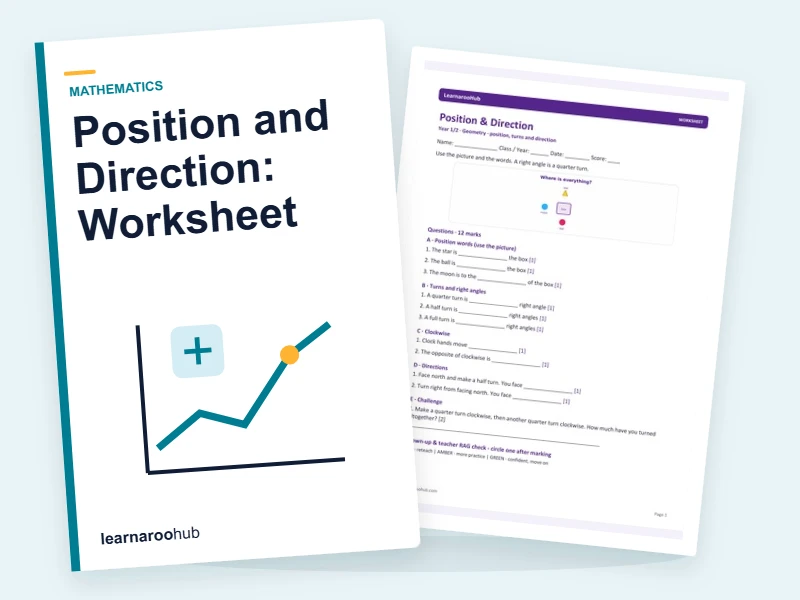 Position and Direction: Worksheet
A four-task worksheet covering position words, direction, turns, and clockwise vs anti-clockwise.
Key Stage 1 Mathematics ⏱ 15m
Printable / PDF
· 15m
PAID
Open resource →
Position and Direction: Worksheet
A four-task worksheet covering position words, direction, turns, and clockwise vs anti-clockwise.
Key Stage 1 Mathematics ⏱ 15m
Printable / PDF
· 15m
PAID
Open resource →
