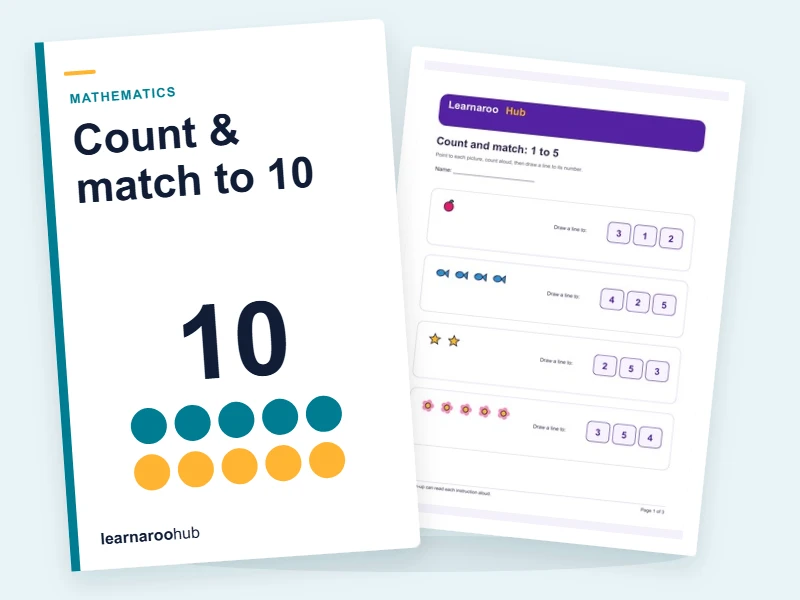
 Count & Match to 10
A gentle 3-page counting sheet for ages 3–5: count the pictures, find the matching number, and trace it. Best done si…
Early Years (EYFS) Mathematics ⏱ 30m
Printable / PDF
· 30m
FREE
Open resource →
Flashcard DeckFree to use
Numbers 0–10 Flashcards
A 14-card deck.
Not tracking — create a free account to save your progress.Create free account →
0
zero
None at all! An empty hand. 🤚
None at all! An empty hand. 🤚
1
⚫
one
one
2
⚫⚫
two — a pair, like your eyes! 👀
two — a pair, like your eyes! 👀
3
⚫⚫⚫
three
three
4
⚫⚫⚫⚫
four
four
5
⚫⚫⚫⚫⚫
five — one whole hand! ✋
five — one whole hand! ✋
6
⚫⚫⚫⚫⚫
⚫
six — five and one more
⚫
six — five and one more
7
⚫⚫⚫⚫⚫
⚫⚫
seven — five and two more
⚫⚫
seven — five and two more
8
⚫⚫⚫⚫⚫
⚫⚫⚫
eight
⚫⚫⚫
eight
9
⚫⚫⚫⚫⚫
⚫⚫⚫⚫
nine — one less than ten
⚫⚫⚫⚫
nine — one less than ten
10
⚫⚫⚫⚫⚫
⚫⚫⚫⚫⚫
ten — two whole hands! 🙌
⚫⚫⚫⚫⚫
ten — two whole hands! 🙌
more
a bigger amount
🍎🍎🍎 is more than 🍎🍎
🍎🍎🍎 is more than 🍎🍎
fewer
a smaller amount
🐟🐟 is fewer than 🐟🐟🐟🐟
🐟🐟 is fewer than 🐟🐟🐟🐟
double
the same amount twice
Double 3 is 3 and 3 = 6. 🎲🎲
Double 3 is 3 and 3 = 6. 🎲🎲
Click or tap a card to flip it. With a keyboard, use Tab to choose a card, then Enter or Space to flip it. Scroll down to see more cards.
Sign in to mark this as complete and track it on your dashboard.Sign in →
Related modules
Count & Match to 10
A gentle 3-page counting sheet for ages 3–5: count the pictures, find the matching number, and trace it. Best done si…
Early Years (EYFS) Mathematics ⏱ 30m
Printable / PDF
· 30m
FREE
Open resource →
 Numbers to 10: A First Look
A gentle 6-slide picture lesson showing each amount as dots, fingers and a ten frame — to share together and talk abo…
Key Stage 1 Mathematics ⏱ 8m
E-Learning Module
· 8m
PAID
Open resource →
 How Many? A Counting Quiz
8 friendly picture questions about counting and comparing amounts to 10. Read the question aloud to your child and le…
Early Years (EYFS) Mathematics ⏱ 15m
Quiz
· 15m
FREE
Open resource →
 Numbers at Home: A Guide for Grown-Ups
Five quick ideas for building your child's number sense through everyday play — no worksheets, no pressure.
Early Years (EYFS) Mathematics ⏱ 6m
E-Learning Module
· 6m
FREE
Open resource →
 Numbers to 5 (EYFS)
A gentle, parent-led Reception (EYFS) maths activity book — counting and subitising to 5, matching numerals, one more…
Early Years (EYFS) Mathematics ⏱ 20m
Activity Book
· 20m
FREE
Open resource →
 Numbers to 10 (EYFS)
A gentle, parent-led Reception (EYFS) maths activity book — counting to 10 forwards and backwards, numerals, one more…
Early Years (EYFS) Mathematics ⏱ 20m
Activity Book
· 20m
FREE
Open resource →
 Patterns & Numbers to 20 (EYFS)
A gentle, parent-led Reception (EYFS) summer-term maths activity book — counting to 20, teen numbers as 10 and some m…
Early Years (EYFS) Mathematics ⏱ 20m
Activity Book
· 20m
FREE
Open resource →
 Where Is It? Position & Direction (EYFS)
A gentle, parent-led Reception (EYFS) maths activity book — position words like on, under, behind and between, direct…
Early Years (EYFS) Mathematics ⏱ 20m
Activity Book
· 20m
FREE
Open resource →
