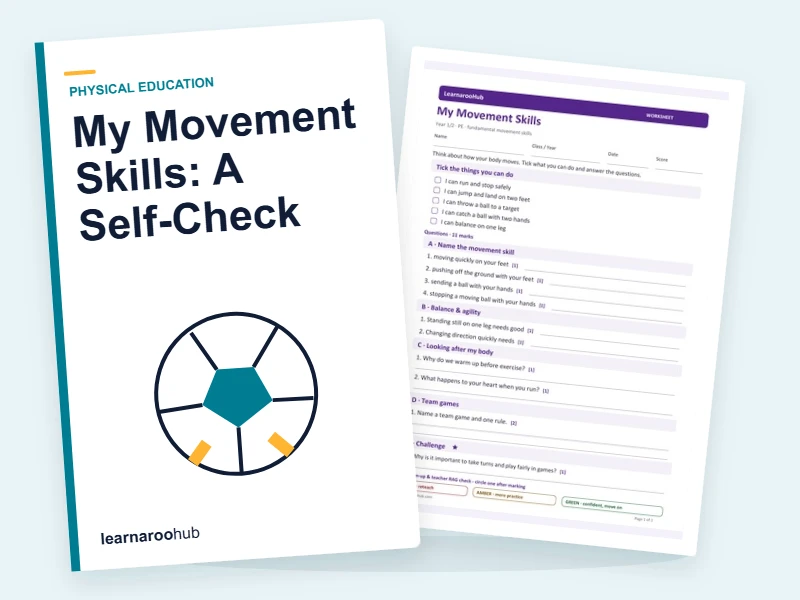
 My Movement Skills: A Self-Check
One-page KS1 PE sheet: five movement self-check ticks and an 11-mark written check on movement words, warming up, tea…
Key Stage 1 Physical Education ⏱ 15m
Printable / PDF
· 15m
PAID
Open resource →
My Movement Skills: A Self-Check
One-page KS1 PE sheet: five movement self-check ticks and an 11-mark written check on movement words, warming up, tea…
Key Stage 1 Physical Education ⏱ 15m
Printable / PDF
· 15m
PAID
Open resource →
E-Learning ModulePaid subscription
PE at Home: A Guide for Grown-Ups
Prefer not to join? Buy just this resource
One-off price: £1.29
This resource is also included with eligible paid plans.
Buy this resource — £1.29Create a free Learning Locker first; the exact resource and price are confirmed before payment.
Related modules
My Movement Skills: A Self-Check
One-page KS1 PE sheet: five movement self-check ticks and an 11-mark written check on movement words, warming up, tea…
Key Stage 1 Physical Education ⏱ 15m
Printable / PDF
· 15m
PAID
Open resource →
 Why We Move: The Big Ideas of PE
6 slides on the three fundamental movement skills, why we warm up, how to play fairly, and why dance counts as PE too.
Key Stage 1 Physical Education ⏱ 8m
E-Learning Module
· 8m
PAID
Open resource →
Why We Move: The Big Ideas of PE
6 slides on the three fundamental movement skills, why we warm up, how to play fairly, and why dance counts as PE too.
Key Stage 1 Physical Education ⏱ 8m
E-Learning Module
· 8m
PAID
Open resource →
 PE Quiz: Movement Skills, Games & Healthy Bodies
10 questions on fundamental movement skills, warming up, attack vs defend, and what makes a healthy active body.
Key Stage 1 Physical Education ⏱ 20m
Quiz
· 20m
PAID
Open resource →
PE Quiz: Movement Skills, Games & Healthy Bodies
10 questions on fundamental movement skills, warming up, attack vs defend, and what makes a healthy active body.
Key Stage 1 Physical Education ⏱ 20m
Quiz
· 20m
PAID
Open resource →
 PE Words: Flashcards
12 flip cards with useful words for talking about movement and games: locomotor, stability, manipulative, agility, co…
Key Stage 1 Physical Education ⏱ 15m
Flashcard Deck
· 15m
PAID
Open resource →
PE Words: Flashcards
12 flip cards with useful words for talking about movement and games: locomotor, stability, manipulative, agility, co…
Key Stage 1 Physical Education ⏱ 15m
Flashcard Deck
· 15m
PAID
Open resource →
 Five PE Games for Home & Garden
Five active KS1 PE games to play at home or in the garden — running, throwing and catching, balancing, jumping and a …
Key Stage 1 Physical Education ⏱ 60m
Activity Book
· 60m
PAID
Open resource →
Five PE Games for Home & Garden
Five active KS1 PE games to play at home or in the garden — running, throwing and catching, balancing, jumping and a …
Key Stage 1 Physical Education ⏱ 60m
Activity Book
· 60m
PAID
Open resource →
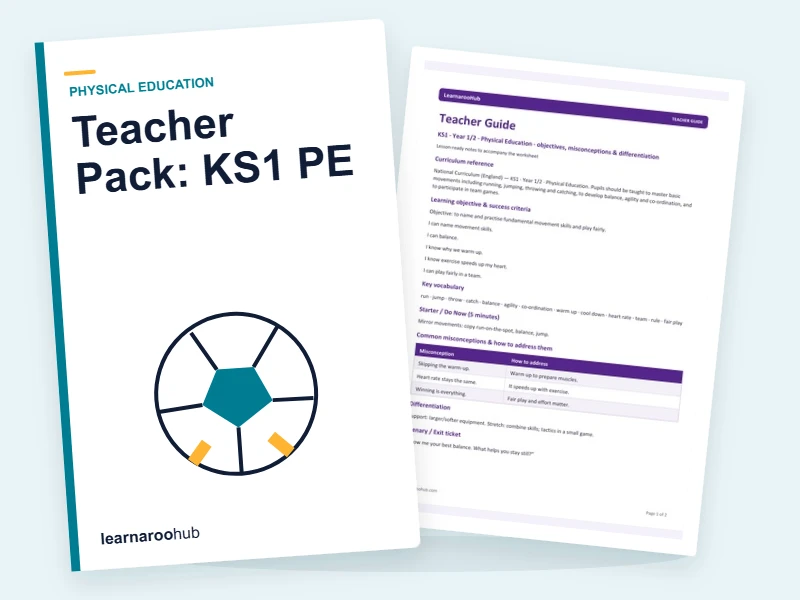 Teacher Pack: KS1 PE
KS1 PE curriculum mapping, movement-skill teaching ideas, inclusion and safety prompts, and a suggested six-lesson se…
Key Stage 1 Physical Education ⏱ 30m
Printable / PDF
· 30m
PAID
Open resource →
Teacher Pack: KS1 PE
KS1 PE curriculum mapping, movement-skill teaching ideas, inclusion and safety prompts, and a suggested six-lesson se…
Key Stage 1 Physical Education ⏱ 30m
Printable / PDF
· 30m
PAID
Open resource →
